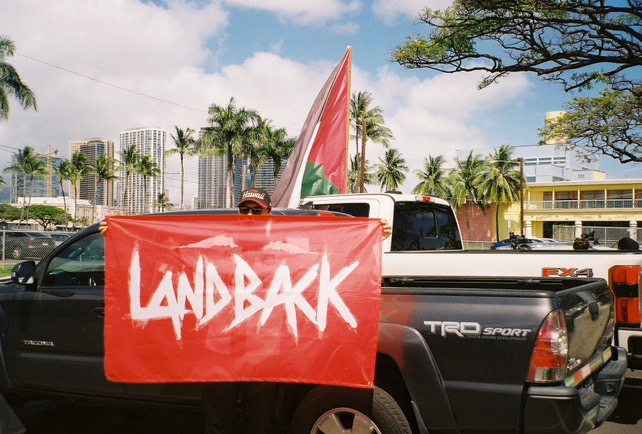
by Kauwila Mahi
In a lesser known track by Method Man on the Tical album in 1994 “Meth” admires the Palestinian Liberation Organization’s unconventional resistance tactics with the lyric “I live by the code, style – it’s mad – P.L.O.” This framing by Method Man is important to understand the role of music in sustaining our movements and the eruptions and shifts that occur in our movements guiding us towards liberation.
On speakers throughout Hawaiʻi “Nā Kiʻowai, nā pūnāwai, kaulana o Palesetina” interpreted “The famed pools, the famed springs of Palestine” echos through speakers. These lyrics are a k/new composition which borrow from its parent song, a kanikau, a composition lamenting a loss that is grounded in place and draws connections between an ʻāina (land) and the person for whom the kanikau was composed. On October 7th last year I was restless and drawn to seek the way my ancestors sought connection with Palesetina. Among the thousands archival materials engraving connections between Hawaiʻi and Palestine was a kanikau dedicated to Timoteo Haʻalilio, one of our high chiefs who secured kō Hawaiʻi Pae ʻĀina (the Hawaiian Archipelago) as an independent nation-state in 1843 and passed away on the way home to Hawaiʻi from European powers in 1844. I sampled the original composition which traces Timoteo Haʻalilio to lands, chiefs, and ancestral gods famed in our moʻolelo (history) and then recalls Palesetina as follows without modern orthography: “Aloha na waipuna a me na kio wai o Palesetina” interpreted as “Love to the springs and pools of Palestine.”
Over the last year, we were reminded that colonialists disguise themselves as neighbors, professors, corporations, or presidents and that sometimes our people yearn to wear the same hat. My commitment to a disciplined and principled solidarity with my relatives in Palestine came from recognizing that the struggle for every liberationist is never done in isolation; our connections to each other is what binds the future the world need. I shifted my focus to unearth archival connections and educating people about these connections in my own community through ʻŌlelo Hawaiʻi (Hawaiian Language). Part of this decolonial education emphasized that our kūpuna (ancestors) studied and participated in movements throughout the world during 19th and 20th century. The instrumental work of the late Haunani-Kay Trask consistently drew connections between Hawaiʻi and Palesetine and other struggles around the world since the 1980’s and it is a guide by which many of us have shifted our politic advocating for mutual recognition as forms of nationhood that far predate western notions of sovereignty.
Although it may feel hopeless to be on the other side of the world witnessing innumerable erasures taking place because of genocidal campaigns of colonialists, disciplined and principled solidarity is of the utmost importance. The Palestinian struggle has awakened the world but for us in Hawaiʻi nei our deep-seeded love and commitment to our lands is a mutual form of recognition. When listening to Palestinians sharing their connection to olive trees it echoes hauntingly similar rhythms to Kānaka Maoli speaking about kalo (taro).
At 1:00 am on a random Saturday, I checked my daughter’s notes in her iPad to see if she left any letters for our family to read. While most were simply emoji expressions of her day-to-day life, one note in particular read “I love Palestine, Free Free Palestine” with the Palestinian Flag and heart emoticons. Some may wonder if the next generation is ready to take the helm and incite change but the letter my daughter wrote reminded me. Every struggle for liberation is a part of my nation.
Daniel Kauwila Mahi is an ʻŌiwi Hawaiʻi visual artist, researcher, video game designer, and composer from Honolulu, Hawaiʻi.
 Indigenous Solidarity with Palestine
Leave a comment