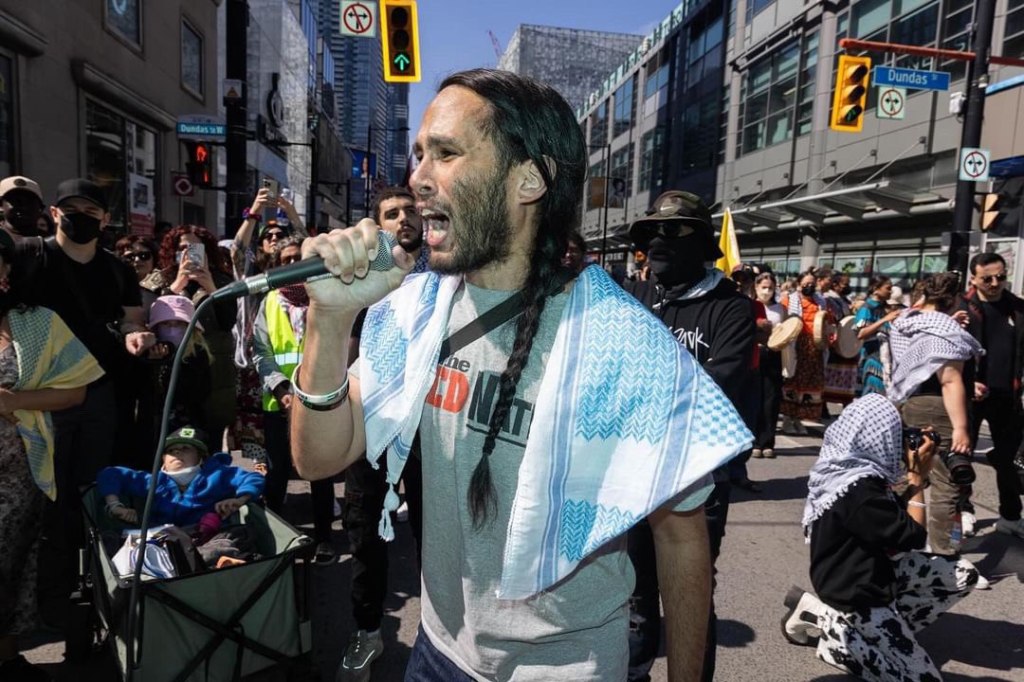

Photo Credit: Ammar Bowaihl
by Uahikea Maile
This essay is based on a speech originally delivered on May 18, 2024 in Toronto during a demonstration marking three years since the discovery of a mass grave of 215 Native children at the Kamloops Indian Residential School in British Columbia. Toronto Indigenous Harm Reduction, Palestinian Youth Movement, and Toronto 4 Palestine hosted the rally and march, as a joint Indigenous and Palestinian demonstration, to honor children subjected to colonial genocide from Turtle Island to Palestine. Mahalo piha and deep gratitude to the organizers who invited me to offer that speech, as well as Leanne Betasamosake Simpson and Nick Estes for coordinating our collective contributions here.
As a young person, from 2002 to 2006, I attended an Indian Boarding School in Hawaiʻi.
It’s true that even in the Hawaiian Islands, beyond Turtle Island, Native Hawaiian children were removed from their families and communities to colonial institutions bent on domesticating, assimilating, and eliminating the Native.
The US Department of Interior published a report in 2022 identifying, from 1819 to 1969, the Indian Boarding School system consisted of 408 federal schools across 37 states or then territories, including 21 in Alaska and 7 in Hawaiʻi.
Indigenous peoples are recognized, and recognize each other, because of this unique yet shared experience with settler colonialism, and also because of our unique yet shared resistance to it.
Our existence and persistence today proves that settler colonialism is in decay and failing.
The infamous US Captain Richard Henry Pratt, founder and superintendent of Carlisle Indian Industrial School established in Pennsylvania in 1879, in a speech entitled “The Advantages of Mingling Indians with Whites” extolled: “A great general has said that the only good Indian is a dead one, and that high sanction of his destruction has been an enormous factor in promoting Indian massacres.” “In a sense,” Pratt continued, “I agree with the sentiment, but only in this: that all the Indian there is in the race should be dead. Kill the Indian in him, and save the man.”
The spectacular genocidal wars waged on American Indians by the US government and its military led to still genocidal policies of containment in the establishment of the reservation system and assimilation through boarding schools. These genocidal wars to ethnically cleanse Indigenous communities and genocidal policies to eradicate Indigenous peoples as distinct people spread like wildfire globally, igniting in what became Canada as well as places like South Africa, Australia, New Zealand, Hawaiʻi, and Palestine.
US and Canadian subjugation of Indigenous peoples in these territories became a colonial blueprint for settlement, apartheid, occupation, and genocide elsewhere.
It is the colonial tradition and savage culture of murderous settler states, whereas ours—as Indigenous peoples who love our land and that which feeds—is one of enduring resistance; a five-century fight for collective liberation.
Make no mistake. Liberation lies in the recognition of relationship between one another and practices of solidarity, living together in a fight premised on our shared destruction and erasure. And make no mistake, this is precisely why the same Indian residential school and mass grave denialists—in Tkaronto, Dish With One Spoon Territory, and Treaty 13—zealously deny the Zionist entity’s genocide of Palestinians in Gaza.
When we say every child matters, it must mean every child subjected to settler colonial genocide.
Every child matters, from Kamloops to Gaza! When I say “every child matters” you say “from Kamloops to Gaza!”
Every child matters from Kamloops to Gaza! Every child matters from Kamloops to Gaza! Every child matters from Kamloops to Gaza!
Uahikea Maile is a Kanaka Maoli scholar, organizer, and practitioner from Maunawili on the island of O‘ahu. He is assistant professor in the Department of Race, Diaspora, and Indigeneity at the University of Chicago.
 Indigenous Solidarity with Palestine
Leave a comment