by Jamaica Heolimeleikalani Osorio
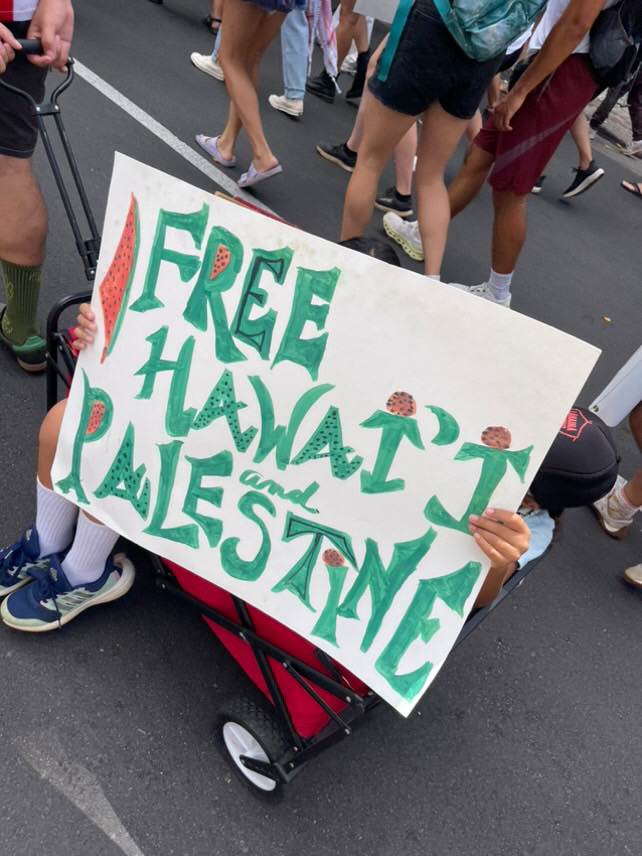
Credit: Malia Osorio
Like most native kids queered by colonialism, I spent much of my life trying to understand aloha. I often felt an existential need to find and make aloha in my own image, this would eventually define my young years. In my adolescence I turned beyond the individual to the collective practice of aloha. I studied aloha and the Hawaiian movement from my father’s mountain range shoulders. In his shadow, I was ever inspired by the way aloha has held and challenged our movement and people. As an adult I turned my study to my ancestors. The last decade in particular was dedicated to a study of aloha (ʻāina) and the distinctness of ʻōwi practices of care, desire, and intimacy that are rooted in and learned from the land. I aimed to (re)member where and how we learn aloha – and where, how, and for what purposes is it commercialized and desecrated. In recent years, my little ancestors, my 3-year-old daughter and 6-month-old son have become my mentors in aloha, softening and opening the parts of me that have long hardened and closed. They have depended on my commitment to honoring the preciousness of aloha.
I say all of this to set a foundation that has now been shattered. I have lived my whole life most profoundly wishing to know aloha, and I have studied it in all the common and expected places. And still nothing would teach me more about this crucial human practice like the Palestinian struggle for freedom. Not even our precious aloha ʻāina has transformed me and my spirit such as the Palestinian fight for life amidst the Israels genocidal campaign.
Aloha for the land they will not abandon
Aloha for each other they will not forsake
Aloha for future they will not surrender
Aloha in the hands of baker, stretching carbs for his starving community
Aloha in the bloodied fingertips of the father, pulling his family from the rubble with his bare hands
Aloha in the trembling voice of the mother, crying out her grief, refusing to be ignored
Aloha in the burdened shoulders of the son, hiking half his weight in flour daily to feed his family and friends
Aloha in cracking palms of the daughter, her hands stretched out to hold all that has been left behind or abandoned
Aloha in the sutures of the surgeon, stitching in the dark of night while his hospital shakes in the constant shelling
Aloha in the soil, cradling the bones of the martyrs
Aloha in the kevlar of the journalist, their dark blues promising a sacrifice
Aloha in the diaspora, each of Palestine’s beloved children who will someday surely return to the homes of their parents and grandmothers
Aloha for those who struggle beside them, among them, for them from miles and worlds away
Aloha in the marches, the rallies, the liberated zones
Aloha in the sit-ins, barricades, the freeways shut down
Aloha in the boycotts, the divestments, and the demand for sanctions
Aloha defines this movement
In its anger, despair and even in its rage
It is aloha that holds the center
Should we waste our short time together to speak on the other side? Perhaps not. Suffice it to say, there is no aloha in greed, none in theft, or settlement, or slaughter. There is no aloha in occupation, or colonialism, not even in sovereignty. There is no aloha in genocide or removal, shelling, or ground invasion. There is no Aloha in collective punishment or multibillion dollar weapons packages, none in the UN Security council’s repetitious vetoes. When boiled down to their essence, the state of Israel is simply greed masked in a mission of extermination and our occupiers are happy to support their younger sibling in settlerism.
Perhaps we should instead stay with love—all sides of it.
Its rage, its softness, the way it cries and call out for us
How it resonates not an ideology
But a promise of something far more precious:
The life of the land
Perpetuated in the liberation of its first peoples
I am here to tell you, If you haven’t been paying attention, the movement for Palestinian freedom is a movement of aloha. It is a movement that is teaching us more about ourselves and our own principles and allegiance to that which is precious.
To my Kanaka Maoli ʻohana: Yes, our people first learned aloha from our ʻāina – she taught us reciprocity, care, intimacy, and pleasure. But she is not the only place we can learn how to practice and uphold the radical practice of aloha. There is so much we can, and should, learn from Palestine and her stalwart people. And when we learn, we must turn that knowledge to action. We must turn that knowledge towards freedom. We must turn that knowledge in service to our Palestinian comrades.
I am asking us to pay closer attention. To fail to do so would be to forsake aloha in this critical moment. Many have argued before me that it is aloha that defines the Kanaka Maoli peoples. Perhaps then, to surrender or ignore our duty to aloha in acts of cowardice or in allegiance to some bastard notion of the state and its right to “defend itself,” would be to lose ourselves entirely.
Freeing Palestine is an act of aloha, it is a commitment that will bring us closer to our ancestors, our lands, and our collective humanity. Come and join the struggle.
Dr. Jamaica Heolimeleikalani Osorio is a Kanaka Maoli wahine artist / activist / scholar / educator / storyteller born and raised in Pālolo Valley, Hawaiʻi. She is an Associate Professor of Indigenous and Native Hawaiian Politics at the University of Hawaiʻi, an internationally recognized poet, subject of an award-winning film, This is the Way we Rise, Co-writer of the VR film On the Morning You Wake (To the end of the world), and author of the award winning book Remembering our Intimacies: Moʻolelo, Aloha ʻĀina, and Ea. She believes in the power of aloha ʻāina and collective action to pursue liberatory, decolonial, and abolitionist futures of abundance.
 Indigenous Solidarity with Palestine
Leave a comment