Katsi’tsakwas Ellen Gabriel in Conversation with Leanne Betasamosake Simpson
Leanne: Every September, our communities put on orange t-shirts with “Every Child Matters” written on the front as part of the marking of National Truth and Reconciliation Day. We do it to remember all of the children that were forced into residential schools, to acknowledge the grief of their parents, and to think about all of the children currently coping being separated from their families through the child welfare system. What does “Every Child Matters” mean to you in the contact of Israel’s genocide in Gaza and in Palestine?
Ellen: “Every Child Matters” is really about the preciousness of life, of honoring Indigenous children who went to Indian Residential Schools and those who never came home. They were not allowed to have a childhood because of Canada’s genocidal policy of “Until there is not a single Indian left in Canada”. It didn’t matter how that was done according to Duncan Campbell Scott, one of the authors of the Indian Residential School.
Genocidal acts were committed by clergy and lay people, the torture and abuse of children, thousands killed and now lying in unmarked graves in former Indian Residential Schools across Canada. All done with the full knowledge of the government of Canada. The attack of the family unit, our cultures, our identity for the economic greed of the occupier. In Gaza there are parallels to be made regarding murdered children and their families are buried under the rubble of buildings which were bombed by Israeli missiles: supplied by the US.
Parallels to Gaza can be made around the manner and method used to dispossess Palestinians of their lands. Canada is an occupied state and is the homelands of many different Indigenous peoples. In order to keep the status quo of persistent land dispossession, it is necessary for the colonizer/occupier to dehumanize Indigenous peoples, to justify the violence to clear the land for settlers, and to force us into a colonial court system to fight for our rights to self-determination. Systemic racism which we are witnessing play out at the international level. The human rights are only for those the colonizer deems worthy.
The forcible removal of Indigenous peoples from our traditional homelands; the killing of an identifiable people with a land base, a language, culture and government, and the blatant declaration by state actors of their intent to kill. Parents unable to protect their children from Israeli soldier, tanks and bombs, which includes home invasions. All acts of genocide and crimes against humanity.
Short of bombs falling on our homes, Onkwehón:we (Indigenous peoples) on Turtle Island share parallel experiences at the hands of the occupier. Our history controlled through the lens of the settler who controls our lives through funding agreements. Not on the basis that we are equal or that our rights are human rights. We are both called ‘savages’, our peoples forced under colonial laws to keep us oppressed and struggling to keep our cultures alive. Our peoples’ families helpless to stop the kidnapping of their children – as we have seen in Palestine. Indigenous peoples remain a threat to the power of the colonizer is when we protect our Homelands, we are brutalized as we threaten the economic prosperity of corporate colonizers.
Whether its policing authorities or an army, the forcible removal of peoples from their Homelands is illegal under international human rights law. [United Nations Declaration on the Rights of Indigenous Peoples, article 10:” Indigenous peoples shall not be forcibly removed from their lands or territories.”] But it still happens and in Canada there are many examples of this today. From Kanehsatà:ke to Mig’maki, to Wet’suwet’en homelands, our nations are under attack.
In Indian Residential School system, Indigenous children were made to feel shame for being Indigenous, that their lives didn’t matter. This is especially important for people to understand what the impacts of genocide are: the dehumanization impacts the collective’s self-esteem affecting our identity: thus internalizing cultural shaming. Causing us to believe the occupier’s view of us, that we must be grateful for the crumbs thrown our way. Indigenous peoples are trying to heal from the impacts of this genocide, and colonization. But first, colonial systemic racism must end. The violent nature of the colonizer must be addressed and their brutality must come to an end. There must be a permanent ceasefire before we can even begin talking about peace or the day after.
Leanne: The Anishinaabe are always talking about mino-bimaadiziwin, the good life, or as Winona LaDuke says, the continuous rebirth, as an organize concept and practice for life. To me, it places us in a complex network of relationships with all of the plants, animals, humans and spirits that make up planet earth, and makes us think about what we can give up to promote life. It’s a concept that gives way to a collective way of living that is woven into the ecologies of places we live, but also that connects us to peoples and ecologies far away from us. It teaches us to think very carefully about putting an end to any kind of life, whether that is plant or animal, and it gives way to our practices around harvesting. Since the beginning of October, we’ve seen Israeli Defense Forces use spectacular violence on the people of Gaza. What traditional teachings are compelling you to act right now in defense of Palestine and their struggle for liberation?
Ellen: This is an important question as it reminds us of our traditional teachings that instruct us to respect all life. Even those like the deer we hunt, to place tobacco offerings for their safe passage to the spirit world. When the world witnesses the brutality of the Israeli occupation and the indefensible acts of horror against the innocent civilians, it reminds us that those committing these acts of genocide, are people with “roti’nonkonkarhá:ton” which means “their minds are turned upside down”. It is a disease of the mind. I think of Atotarho, the Onondaga chief whose brutality was legendary, a mass murderer and his frightening physical appearance of snakes in his hair. It took many years to change his upside down mind. But it was changed because the creators of Kaianera’kó:wa were able to convince him that war does not do anyone any good. That peace is the only way forward for our people to survive and exist.
Teaching that peace is possible, is an important part of who we are s the First Peoples of Turtle Island. That acts of war are archaic. Today’s wars have taken the brutality of war to another sick level of death. We see the reliance on technology to tear apart bodies, to use it as a foundation of economies who are already destroying our planet – and her people. Teachings, of peace, of respect for human rights nurtures our minds to think of all life, not just human life.
In our Longhouses, we are taught to vigilantly work towards peace, to have good minds for the kind of world we want now, not just the world of the future. That we must always have hope so that this generation and the faces not yet born will benefit from the work we do, seven generations from now.
Just like in 1492, Doctrines of Superiority, like the papal bulls, religious ideology created the acceptance of oppression and murder of Indigenous peoples as the accepted norm. Again for the greed and covetousness of the occupier who believes that Indigenous peoples are savages, unintelligent, sub-human, as they are doing to Palestinians now. It is the rise of fascism which echo the state of the world before and during WWII. Once again to assert the normalization of the violations of human rights.
We are living in dangerous times that are at a tipping point. But we have these teachings which remind us of the importance the philosophy of ‘one dish one spoon’. That we take from this world, only that which we need to survive with. Imperialism and capitalism clouds our minds on this natural way of looking at life on Mother Earth because contrary to the practices of capitalism, there is a finite amount of resources to use before we can no longer survive. The internalization of capitalism
I think of the teachings of peace under Kaianera’kó:wa that in order to achieve peace, there must be an absence of fear and conflict: this why a ceasefire is so important. Once that is achieved, then Palestinians can rebuild, have time to grieve and honor their dead relatives, to thrive and live in freedom. But that can only happen once the bombing and killing ends.
In the Longhouse we are taught to lift each other up – spiritually and mentally. To respect one another, to have strength or the courage to sit in uncomfortable discussions and put our egos aside, and compassion or love to understand the pain or suffering of the other, to also bring that compassion in everything you do. This will impact seven generations from now.
Western UN member states could benefit from these teachings. Our circular teachings versus the linear way perspective – that practice of survival of the past to help us with the present.
But our teachings also tell us that there is a time for grief. To allow families and communities to bury their dead, to honor them as they make their journey to the spirit world. This is an important part of our teachings too: that respect for the preciousness of life and ceremonies for those who have passed. We do not see that respect being practiced by states like the US and Canada who are supporting this genocide unraveling before our eyes.
We as world citizens, are all feeling the impacts of the censorship because of the rise of fascism. It is based upon the occupier’s definition of what they deem as legal or illegal. It is disturbing to see that supporting peace is considered criminal because it is in support Palestinians to live in peace, and for Jews to live in peace. We are all related, and our human rights are interconnected, inter-related, indivisible: in essence they are universal. That’s a belief I think most Indigenous cultures believe in.
The fact that in purported democracies, censorship is an issue, then freedom of speech is threatened. Under our teachings we have obligations to uphold that peace. As Indigenous peoples, it is our right and under our teachings, the obligation to support our relatives in Palestine.

Leanne: One of the things I learned from you during the uprising in 1990, is that conflicts between Indigenous people and Canada are always rooted in the four hundred years of colonial violence that has systematically targeted our territories for dispossession. In these moments of conflict it can be tremendously difficult to educate the mainstream media and Canadians about the colonial context that got us to the blockade they are seeing. I was thinking about this last week as I was re-reading My Lover is A Freedom Fighter by Rana Shubair, after she was martyred by Isareli bombs in Gaza. The first part of the book is a prologue where starting in 1917 with the British Mandate and the Balfour Declaration, she succinctly moves through the colonial history of Palestine so that readers in the west can understand the context of the novel. Once you know this history, the parallels and links between settler colonialism in Israel and our own experiences with colonialism on Turtle Island. How is the genocide in Gaza and Israeli settler colonialism linked to Indigenous struggles on Turtle Island?
Ellen: They are intricately linked in the sense that our lands were cleared for settlers through acts of genocide. Our homelands were ‘given’ away by those who had no right to give them in the first place. These impositions of oppressive foreign laws over us, has many parallels.
We are not talking about the current bombing of innocent civilians and Gaza’s infrastructure. The method for which our homelands were stolen from us is the same. All the massacres Indigenous peoples endured for the greed of the colonizer, is documented throughout history. The little attention these massacres have in the curriculum of schools is indicative of the collective amnesia and cognitive dissonance of the occupiers of Turtle Island. We were driven into postage stamp sizes pieces of land and expected to thrive: while being forbidden to hunt or restricted access to our Homelands. We are resilient yes, we are survivors because of the strength of our ancestors whose DNA runs in our veins to protect our culture, languages and love for the land.
The first UN special rapporteur on Indigenous issues, Rudolpho Stavenhagen stated that in the first century of ‘contact’ that three quarters (3/4) of the Indigenous population were killed by Europeans through war or disease. As we examine what is happening in Palestine, specifically GAZA, starvation, dehumanization, the lack of safety and security of the peoples’ physical, mental and spiritual health comes under attack, their sacred sites demolished, their identity villainized, all to justify the violence of the occupier for the sake of their economic greed. So to me the parallels between Indigenous peoples and Palestinians is obvious.
The persistent violations of human rights, we see that the common elements are poverty, forced displacement, racist settler colonial laws that deny us the rights to self-determination, and the fact that no matter how much we internalized the oppressors’ definition of us, no matter how much we comply, we will never have our rights respected. Nor will we ever be one of them.
The settler colonial playbook provides the occupier with a framework on how to disrupt and destroy those whom they deem as dispensable. Those who understand how precious is the land, our Mother Earth and her peoples are viewed as inferior.
The practice of land dispossession, the attack on the family unit, the kidnapping of children, the intentional erasure of our languages, our cultures, historical and sacred land marks underneath the concrete jungle of Canada and the United States –or national parks, the criminalization of those defending their rights to their inherent rights to self-determination, the villainizing of land defenders and the lack of truth within school curriculum to teach about the genocidal history of the Americas, and Israel. With the first Nakba in 1948, to the genocide in 1492 by Christopher Columbus and its continuation by the British and French, we see that genocide is the accepted norm.
All the heroes of the colonizer are those whose mission was to kill as many Indians as they could. We see that history books have not changed in their account of the genocide of the Americas. They continue to hide the truth about their brutality. In spite of the many commissions that investigated Canada’s crimes of genocide against Indigenous peoples. As well as in the US, the trail of evidence is there. But settler colonizers refuse to acknowledge the depth of their crimes against Indigenous peoples: and now we are witnessing it in Palestine.
It is what they do best: lie to convince their citizens that the killing of babies, children, their parents is the status quo or norm, because they are the civilized ones. The other – like the Indigenous peoples, must either be eliminated or assimilated for the safety of their civilization.
The murder of innocent people for the sake of empire building and to satisfy the greed and lust for power is what settler colonialism stands for. What we are witnessing in Gaza, indeed all of Palestine, is the same thing that happened to Indigenous peoples of the Americas. We just didn’t have social media when it was happening to us. But history recorded it and today, history is recording every single heinous act of genocide against the Palestinian people.
In 1990, when Kanehsatà:ke and Kahnawake were under Siege, we had our food, medicine, fuel and free passage of our people through police and army checkpoints. It is scary when you live like this but we survived. In Gaza, the so-called democracies are using sophisticated weapons of war to exterminate Palestinians. The fact that all these Western states have signed on to so many international human rights instruments, including, the Geneva Convention which contains the purported, ‘laws of war’, we see the double standards being implemented supported by state propaganda.
These are some of the many situations, that we as Indigenous peoples of Turtle Island share with Palestinians.
As Beesum Youssef, Egyptian comedian and author, whose wife is Palestinian, said this is no longer about Hamas. It is about genocide. Settler colonialism pretends to be a victim all the time to justify their brutality and violent nature. And that was done to Indigenous peoples, and in fact still is when we see the criminalization of Indigenous land defenders.
Leanne: In witnessing these past two months, I see a tremendous love in Palestinian resistance. A love of life, of their culture, of their families, and this beautiful desire to live in their homeland practicing self-determination, alongside Jewish neighbours, as they did before the Zionist state building project. I’ve thought a lot about Palestinian women in these moment. Actually, I’ve also thought a lot about Palestinian men and how they are continually treated by the west as if they are disposable. We’ve watched as Israel has tried to Pink-wash the genocide. Over the years, you and I have come together to organize around a bunch of issues as Indigenous feminists. Why is genocide in Palestine something Indigenous feminists should care about?
Ellen: As women we need to lift each other up. There is something powerful that women’s voices have had over the centuries of decrying the brutality inflicted upon their nations. As one of my elders said, “men think about today, whereas women think of the future.” If we consider the amount of women that have been killed in this genocide, imagine the orphans who now have no mother, no aunties, no grandmothers or sisters or cousins. Women are the foundation upon which most cultures are built upon. Our languages come from our mothers, hence the term, mother tongue. Our values and our identity comes from our mothers. As Indigenous women/feminists, we know there is still a struggle to have our voices taken seriously in this patriarchy. So we must persistently challenge the status quo that would have us relegated to domestic affairs of the home.
I have listened to Palestinian women who resist and while afraid for their families, still grieving over the tremendous loss of life they personally have; they speak eloquently about the fact they would rather die than leave their homeland. It is powerful and heartbreaking at the same time. I have the deepest respect for them who in spite of this insane genocidal attacks upon them, still try to create a semblance of life under the conditions of starvation, no medicine, no safety; they remain defiant.
The fact that so many Palestinian women have remained so strong, so steadfast in their desire to return to their homes, even if they are rubble simply because it is their Homeland, is something we can as Indigenous women, identify with when we remember our ancestors’ stories.
And like Indigenous women, Palestinian women are fighters within the resistance. The long history of women in war has long been overlooked. Palestinian women fighters like Shadia Abu Ghazeleh and Moheba Khorsheed, revolutionary resistance fighters for the freedom and liberation of Palestine. Women like Hanan Ashrawi, politician and activist in the struggle for Palestinian liberation who eloquently speaks to tell the world the truth about Palestinian struggles.
As a woman, I feel a kinship with their defiance and advocacy for their people. As women, our resistance to the colonizer has been equal if not fiercer, than the men.
Onkwehón:we women, under Kaianera’kó:wa, women are the title holders to the land. Under our laws, it is the women, the clan mothers who declare war. We protect the land; the men protect the people. That is our inherent right. And we must not forget that both men and women share the obligation and responsibility in our struggle for freedom. It is the patriarchy which continues to try and erase the importance of women within the resistance movements of Indigenous peoples.
The survival of our nations depends on the active role of women in all democracies. If we believe in the equality of our rights as Indigenous women, we must lift each other up to support women who are also oppressed. Protection and respect for the equality of human rights norms is paramount to achieving peace. It is ridiculous in 2023 that Palestinian women are unable to protect their children, their families because of the double standards in the respect of human rights, that is applied by Western states. It is evident that we are moving towards a fascist world society, something George Orwell wrote in Animal Farm and 1984.
Leanne: During Idle No More, I was part of a lot of discussions about solidarity. Whenever Indigenous peoples are mobilized we ask other movements for support and help and that solidarity is something we cherish. How has that solidarity been important to you and your people when you were defending The Pines in 1990? What does it mean to you to now act in solidarity with Palestine?
Ellen: I remember during the first week of the Crisis in 1990, I was unaware that people were supporting us. I was doing daily media scrums but unaware of what they were reporting and what was happening in the outside world because there was so much going on in the community.
Once I became aware, it lifted my spirits, and the spirits of the people in the community.
The solidarity with Palestine is important because Palestinians are facing a highly technological, and sophisticated weaponry supplied by western states. The acts of genocide, the starvation, the injuries are all catastrophic. If I as an Onkwehón:we person believe in human rights, if we want our rights respected, and we claim to uphold Kaianera’kó:wa, then I have to speak out. It would be hypocritical for me to say I believe in my ancestral teachings and human rights while staying silent during the genocide/ethnic cleansing of innocent Palestinians.
As we watch helplessly on our screens, an evil genocide unfolding, it is more important than ever for Indigenous peoples to show their solidarity, as we too, have been in situations where it seemed/seems like the world was against us.
I come with the teachings of our ancestors, who taught us the spirit of compassion, courage and respect for all life: this is what guides me. This is my duty to uphold and I understand the world through that lens.
Leanne: I was listening to Steven Salaita talk with the podcast “Millennials are Killing Capitalism” yesterday and he was talking about how this genocide in Gaza is playing out on social media and we’re witnessing it in real time, without any political structures, including the UN to address it. There is this assumption that colonialization and colonialism wouldn’t happen today on Turtle Island because international law is stronger, because we have the mass media and people would know what is happening, because we can narrate our own experience of it on social media, and public outrage would stop it. This idea that colonization happened to us as Indigenous peoples because no one was watching, and now, here we are in Gaza and we’re all watching and we have very few mechanisms to stop it.
It’s been both shocking and unsurprising to me to watch all the federal leaders in Canada, until very recently, refuse to demand a cease fire, which I think is the very least our leaders could do at this point. What do you think that means for reconciliation in Canada?
Ellen: Well I don’t think reconciliation has begun. Lots of money has been available for ‘activities’ of learning, of trying to get reconciliation started. But it hasn’t begun because colonization is ongoing. Colonization is ongoing. We still have to go through Canada’s expensive court system to protect and defend our rights to self-determination.
If we look at the coalition of Western states supporting this genocide, all the colonizers who were and still are, participate in the persistent theft of our lands. The ‘reserve’ lands set aside for our ‘benefit and use’, are still being chipped away for urban sprawl, for pipelines and mining or dams. In Kanehsatà:ke we do not have a contiguous land like other ‘reserves’ in Canada. It is a checkerboard like the West Bank, like Palestine. And for over 300 years, we continue to resist the theft of our lands.
As the title holders to the lands, we are still a threat to the economic prosperity of Canada which is a government tightly controlled by corporate lobbyists.
Canada remains stuck in the colonial mindset of imperialism and it is evident that Western countries have been coopted by Israel. Each time Trudeau has spoken even in the slightest bit, against the status quo, he is told by Netanyahu to ‘sssshhh, remember who is your ally or…’. How arrogant and condescending. Canada made a choice, even though now it was part of the over 130 UN member states of the General Assembly who are calling for a ceasefire. The fact remains, that Canada and western states could have stopped this genocide long ago had international human rights law been respected. As it is, I view Canada’s sovereignty as being fragile if other states dictate to it, what it can or cannot do. That being a UN member state is more of a club who embrace economic prosperity, and genocidal acts over the rights of the child, or human rights norms. It is worrisome to see what is unraveling before our eyes and social media has been important in the witnessing the dysfunction of western democracies.
Some of the calls to action by the Truth and Reconciliation Commission, call upon Canada to change the curriculum in schools, for judges, lawyers, all health care professionals, and all of society to learn about the genocidal history of Canada. But we have not really seen the change needed to begin the process of truth telling. Racism is still rampant against Indigenous peoples. The fact that many mainstream media outlets, like the CBC have removed access to comments on their web sites, when it comes to Indigenous stories, because of the amount of racist comments against Indigenous peoples. This alone is evidence that Canada and its provinces are not taking any commission created since 1996, seriously. That the status quo remains because there are no actions accompanying the rhetoric of politicians.
We do not have our land back. We are still relegated to falling under colonial created nepotistic entities that must implement Canada’s laws and policies while ignoring traditional Indigenous governments’, laws and protocols. Until we can have our lands back and jurisdiction over those lands, we cannot say that reconciliation has begun. Society is becoming more aware, which is needed, but it has to go deeper for us to agree that reconciliation has begun.
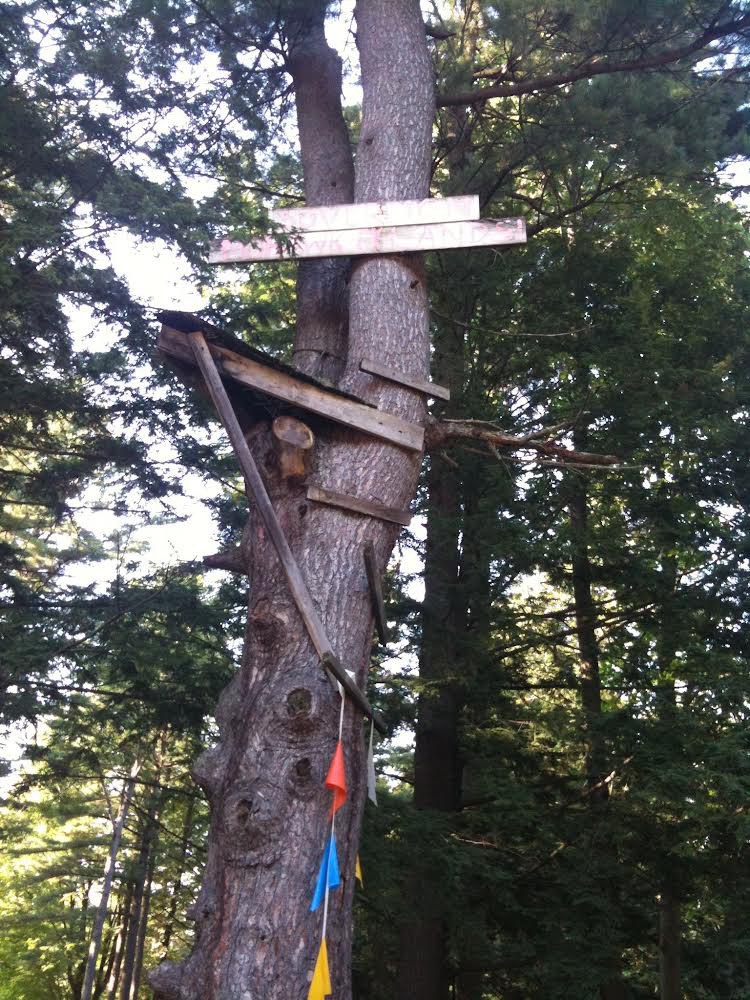
Pictured: “Sovereign Mohawk land,” army snipper platform in Kanasatake during the Oka crisis.
Leanne: We last saw each other in, at a book event for Rehearsals for Living. It feels like everything has gotten much worse. What kind of a world are you interested in building? What are your dreams and visions for the coming generations of Anishinaabe, Haudenosaunee and Palestinians?
Ellen: Both you and Robyn’s vision is heartwarming and strong in its vision to bring about a kinder and more compassionate world, especially considering the time of the pandemic you wrote these letters.
I dream of a world where we are all courageous enough to sit in uncomfortable discussions to promote and find a way for peace, security and respect for human rights. A society where we can respect each other’s differences and come to some sort of understanding that the work and decisions we do today, will impact the quality of life for the present generation and for the faces not yet born.
Creating a world and generations who practice kindness, who respect the land and understand its importance in our survival and a world who works tirelessly for peace.
Combatting climate crisis in an honest way, in which we are leaving a legacy whereby future generations can survive. To have control over the education of Indigenous children who learn both their ancestral and western teachings.
I would love to see our Homelands restored under our jurisdiction, that Indigenous women’s role in our society is restored – that our rights to self-determination are respected. I would love to see Indigenous peoples using sustainable practices of living off the land. To protect all our relations we mention in Ohén:ton Kariwatékwa, like the waters to be safe to drink, to protect our medicines and green plants, the trees, the birds, the fish and the kind of spirituality which continues the connection to the land, our first mother; Mother Earth.
I dream of Peace for Palestine and all oppressed peoples. To be free from hunger, violence, bombing, genocides, from femicide, free from racism, free from hate. That love and peace will prevail and history will remember what is happening in Gaza, Palestine. That we create a world whereby, choosing a leader is based on their kindness, their ability to remember the past so genocides will never happen again: to have respect for human rights, and the rights of Mother Earth. Leaders with good mind who can guide the people in a true democracy and where all citizens take an active part in ensuring the protection of all that is good.
Leanne: What would you say in this moments to Palestinians in Gaza, in the West Bank, in all of Palestine and in the Palestinian diaspora?
Ellen:My message would be that we see them, we send our love and respect to them. We know that they are living a genocide and they are family to us. We are listening to their voices even if the leaders of the world don’t care, we do. We hear them, that they are precious to the world and their existence, enriches the world. That we, their allies will continue to work for their freedom, because they are part of us, as one human family.
Even though I have never met them, as I watch their reels, their lives under the occupier’s genocide, that I see their humanity has never wavered. That I love and respect them for their strength: for showing the world the richness for their culture, and their love for each other and their land. They are our relatives and we support them.
I wish that we as the people of the world united in our support for Palestinians, had the power to stop this madness. That we as the people of the world, united with Palestine for freedom, will hold our leaders to account for their complicity in this genocide.
If we could bring food ourselves, if we could bring you to our homes to be safe and sit together to tell each other our stories of resistance, share our songs, share our stories of our love for the land, for our history. Then bring you back to homes that have been rebuilt, in Palestine.
I was born Kanien’kehá:ka, Turtle Clan, but today I am Palestinian because you are our sisters and brothers who, like us, are strong in our beliefs and resistance.
Leanne: If there are Indigenous people who are reading this, who don’t know much about Palestine or the history of colonialism there, and who are new to this issue, what advice do you have for them?
Ellen: There are reading lists that have been put together. It is important is to read books by Palestinian authors and poets, to follow Gaza journalists reporting from Palestine, read history, and how Palestinians’ land was stolen just like the Indigenous peoples of Turtle Island.
Watch documentaries about the 1948 Nakba like Tantura, Born in Gaza, and fiction like Farha about the 1948 Nakba. Follow journalists in Gaza like Bisan Owada, Motaz Azaiza, Plestia Alaqad, or Israeli journalists like Gideon Levy or historians like Illan Pappé who describe the mentality which they no longer subscribe to, which is the Zionist ideology.
It is important for people to know that Zionism is not Judaism but is an ideology similar to the Doctrines of Superiority which European monarchs of the 15th Century and the Vatican’s papal bulls justified their genocide of Indigenous peoples of the Americas. People cannot base their opinions about Palestinians by biases of western media. Have a critical eye and know the history and culture of Palestine, which is rich comprised of courageous and strong people who have never given up resisting… just like us. Because the same propaganda that is now being spun by western media, also happened to our people through religious ideology and racist doctrines of superiority. And it is happening still.
What is happening to Palestinians should move people’s humanity. If leaders can brazenly support genocide, who is next?!
Leanne: Nia:wen and Chi’miigwech for visiting with me Ellen. My people, the Michi Saagiig Nishnaabeg have learned so much from your people in terms of sharing the land, diplomacy and this practice of peace. I appreciate your wisdom, your commitment to peace and your solidarity with our relatives struggling for liberation in Palestine.
Katsi’tsakwas Ellen Gabriel was well-known to the public when she was chosen by the People of the Longhouse and her community of Kanehsatà:ke to be their spokesperson during the 1990 “Oka” Crisis or the 1990 Kanehsatà:ke/Kahnawake Siege; to protect the Pines from the expansion of a 9-hole golf course in Kanehsatà:ke, known more popularly by the colonial imposed name of “Oka”.
Leanne Betasamosake Simpson is a Michi Saagiig Nishnaabe writer, musician and academic.
 Indigenous Solidarity with Palestine
Leave a comment